Showing posts with label HS2. Show all posts

Tuesday, 1 December 2020

Liverpool International Railway Station

Requirements

One of the questions that come up every so often is "If Liverpool gets an HS2/NPR connection where will the station be?". It is a difficult question to answer, Steve Rotheram and the LCR have effectively ruled out expanding Lime Street, saying it is simply not possible, and I completely agree. This hasn't stopped some people, who seem more interested in the architecture than the practicality of the solution.

It is important to set out the requirements for a proper connection. For me, this is full length 400m GC gauge trains. The LCR has added close proximity to Lime Street and the existing station to that I'd add it needs to be outside the loop for practical reasons.

The space we need is defined by the with of a GC Gauge carriage,  which is 3.29m, the platforms at a minimum of 12m with an extra meter for wiggle room giving a total of 19.58m per 2 line set. For simplicity let's call it 20m.

The absolute minimum number of platforms is 4 this assumes HS2 & NPR, in reality adding some extra platforms for intentional and classic long-distance makes sense, so a more realistic size is 6 or 8 platforms. this would allow for reasonable expansion or transfer of all long-distance express trains to the new station. Leavening regional and semi-fast for Lime street & local for Central station. This means we are looking for a site 60m or 80m wide.

 Location

I do have a site in mind which fore fills all the requirements with perhaps up to 100m available if a small amount of pavement is taken. That site is currently occupied by the Mount Pleasant Car Park and the 051 nightclub, between Mount Pleasant and Brownlow Hill.

Taking 80m line and extending 450m forward takes the end of the platforms to under the cathedral.

Building

The land climbs from the Lime street and is some 10 meters higher by May Street several meters of headspace would be needed for this interface. Having 2 concourses allows the lower concourse at the platform end to be a reasonable size and to be constructed in a pit providing a cliff-like at May Street for the tunnelling to start, meeting the incoming 2 line tunnel.

Constructing an 80m span underground would be challenging.  Leaving supporting walls or building the walls would make the task easier, 3 walls each of 1m would add only 3m to the overall width and arranged as below they would provide fireproof divides between each platform in the underground section. 

Track layout.


Since the King's Cross fire there have been very strict rules for underground stations design to reduce the risks from fire. One of these is for excellent ventilation, to remove fumes, while the upper booking hall would prevent natural vertical ventilation, it could be provided lateral or vertically at the edge.
This would be unlikely to provide sufficient ventilation for the platforms. To accomplish this providing force extraction/insertion via vertical shafts at the end of the platforms could provide the needed throughput for the platforms with the Lower concourse side vents providing the entrance or exit points.
This would leave the area above the concourses free for use as a significant building.

Connections


Providing access to Liverpool's other main stations via travelators could utilise the existent access to central from the basement of Lewis's.

A station of this size would likely mean that other than an expansion of Liverpool central no new station would be needed for 100 years. Providing support for an international connection via the channel tunnel.

Full Connection

I know that currently HS2 plans barely include Liverpool as anything other than a minor adjunct but here are several plans for a dedicated Liverpool line from 20 Miles More to my own far cheaper plan here at Lymm to Lime Street.


Saturday, 3 September 2016

Lymm to Lime Street

Having worked out a route for HS2 to connect to Liverpool with minimum fuss and cost I thought I had better price it. I found some estimates done in 2007 by Network rail for upgrading various lines to GB & GC gauge to take double decker trains or extra long trains. It is Version: 1.21Preliminary Evaluation of Double Deck Extra Long Train Operations Table 1.3 provided most of the information.


The plan I outlined requires the upgrade of the Ditton to Lime Street section which already has OHLE, so I used the figures for the London-Ipswich Route which is similar.

For Bank Quay to Ditton, the line exists but is not electrified, so I took the low from London -> Brighton and the high from London to Southampton.

To estimate the reinstatement of the line from East of Lymm to Bank Quay was a little trickier, I took the numbers from HS2 own estimates for Phase 2 and took out the irrelevant bits. Such as there being no Tunnels this gives a cost of £64 million per mile of which on £17 is construction costs.


Route Miles Min m£ Max m£ Low Per Mile High Per Mile
London →Brighton 51 810 1200 15.8823529412 23.5294117647
London →Ipswich 68 890 1340 13.0882352941 19.7058823529
London →Southampton 79 610 1440 7.7215189873 18.2278481013
London →Oxford 63 800 1720 12.6984126984 27.3015873016
HS new build


64.375 126.333504


Ditton-> Lime Street 10 130.8823529412 197.0588235294

Warrington BQ->Ditton 8 61.7721518987 188.2352941176


192.6545048399 385.2941176471


2007->2016 Pounds 1.31 252.3774013403 504.7352941176


East of Lymm 8 515 1010.668032


Total 26 767.3774013403 1515.4033261177


from my spreadsheet East of Lymm to Lime Street.

If we take the cost of East of Lymm down to just construction, then the total cost is £469m, if you wanted you could knock another £130 million off and just have the classic compatible running into Lime Street. I'm assuming that there would be little to saved by using only W10 on reinstatements and upgrades. So that should be done to GC gauge.
These numbers do not include building a new station at Lime Street or a complex remodeling of Ditton junction, to bring the lines in from Warrington to the centre 2 without crossing at grade, which would be needed for optimal performance, as would a complex junction between HS2 and this spur or the extra work needed on the viaduct over the Manchester Ship canal. Nor does it involve and remodelling of the route around Warrington Bank Quay. This is simply to get the trains through with no traffic.
So a cost of between £0.5 billion and £1.5 billion doesn't sound unreasonable, just to be on the safe side say 1 billion. It is still less than Liverpool City council offered to pay.

Wednesday, 16 March 2016

Liverpool HS2/HS3 Junction

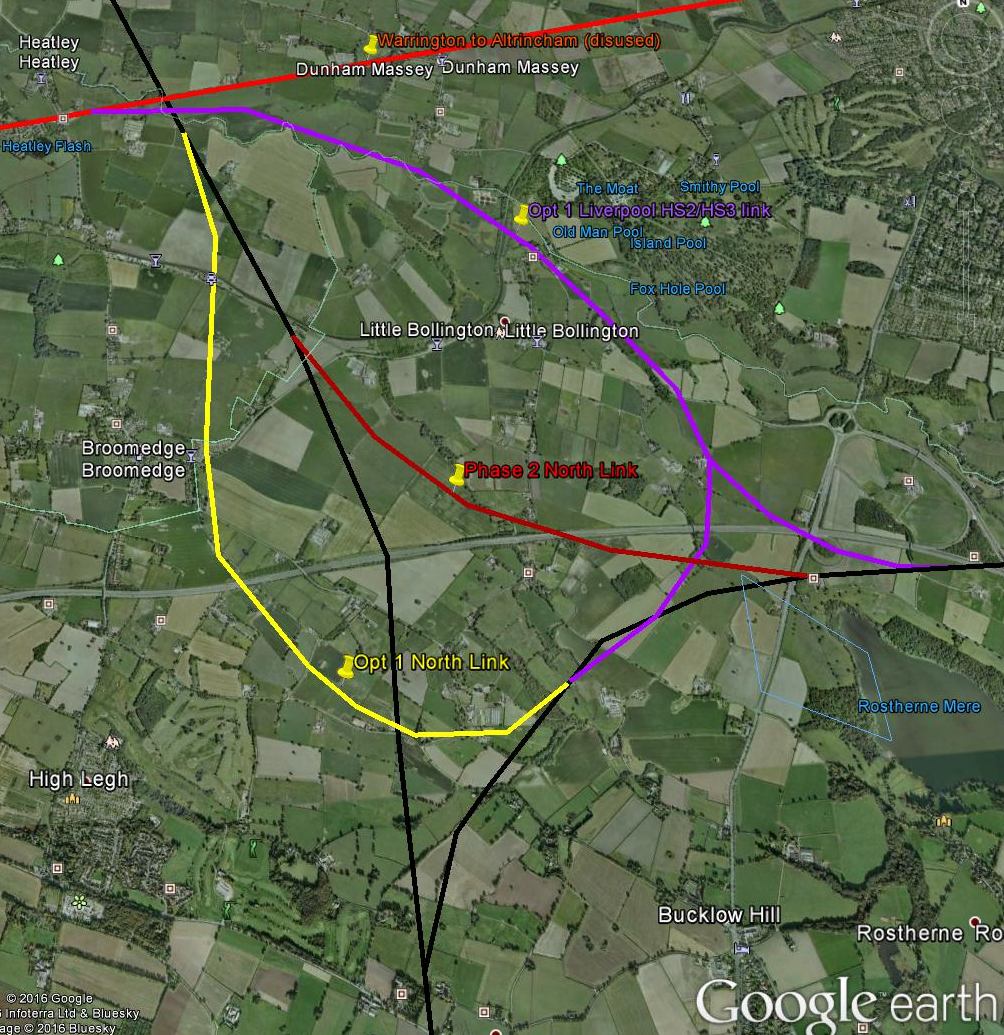
I have given some thought to the junction that would link my preferred HS2/Liverpool link to
the planned trunk. The requirements I set were a straight through connection to Manchester without using the main north-south trunk, no increase in the set of points on the main trunk and keeping speed as high as possible.
In the end, I came up with 3 options the Option 1 fulfils all these criteria, with minimal changes to the existing HS2 phase 2 plan. Option 2 would require some changes to keep the number of points down, while Option 3 is the simplest and comprises most of the principles, but is the one with the least new land take but also the slowest speeds, due to the tight radii of the curves. In order to keep within HS2 already published acceleration and speed requirements the line around the junction would need to be quaded but this, I believe has been allowed for in the original plans. I have assumed that the route to Liverpool uses the Warrington and Altrincham Junction Railway at least through Warrington.
The maximum speed that seems acceptable on curves is given by the table below, the data is taken from Minimum railway curve radius with the diagrams I have had to approximate the curves.

Curve radius ≤ 33 m/s
= 73mph
≤ 56 m/s
= 125mph
≤ 69 m/s
= 154mph
≤ 83 m/s
= 185mph
≤ 97 m/s
= 216mph
≤ 111 m/s
= 248mph
Cant 160 mm, cant deficiency 100 mm, no tilting trains 630 m 1800 m 2800 m 4000 m 5400 m 7000 m
Cant 160 mm, cant deficiency 200 mm, with tilting trains 450 m 1300 m 2000 m no tilting trains planned for these speeds

North Junction

The existing proposal for phase 2 includes a junction north to east, I am not entirely sure why, given current plans have the GC route finishing before Wigan, any trains from Manchester north would have to be classic compatible and   already some routes north available via those, the same is true for Liverpool northward. So, for the purposes of this blog, I will consider the routes north to be optional though I will leave the existing planned line in red.

Option 1

DIagram of a junction bwteen a reinstated Warrington and Altincham line and HS2. The disused Altrincham line crosses from the west at thetop of the picture. A large chord curves around to the south connecting to the southern spur of the junction proposed in the HS2 phase 2 document, heading south. A reflex chord departs and joins the route into Manchester.
This arrangement fulfils all the criteria keeping to radii of over 5000m allowing running speeds of over 200mph. It would eliminate the north chord suggest for phase 2 and replace it with a longer chord further west. It would, however, entail going through 270 degrees to transit between Liverpool and HS2 north.
It is unlikely that such speeds would be permitted on the section of line from Warrington as it passes through some residential areas making the large radii redundant.

Option 2

A straight line departs from the Alricham line and heased south east crossing the route of HS2 and joing the manchester spur, a chord leaves half way along its lnegth and curves south joing the HS2 trunk heading south.
The simplest way to avoid some of the line speed restrictions would be to leave the Warrington Altrincham route earlier, to the west of Lymm close to the M6, to avoid steep turns it would mean leaving the route before the M6 so the existing under pass could not be used. It would involve taking a new cross country route of some 8km to link to the Manchester spur, with a chord to the south, which could use the same sets of points on the trunk as the Manchester spur.
To the north, the chord would have to be somewhat tighter and may involve adjustments to the north junction proposed for phase 2 in order to keep the points countdown. However,   geometrically it is the simplest junction and involves little change to the routings planned in phase 2.

Option 3

A very simple junction is provided with tight curves connecting the Warrington and Altrincham route to the HS2 route north and south.
This is by far the simplest option reusing the maximum amount of old right away and adding the minimum new track, it does this by sacrificing speed the curves from the Liverpool route to HS2 are of about 500-600m in radii limiting speed to 70 mph. There would no option but adding points to any northern routing.
However, if the section of line between the northern crossing was quad, all the way to and beyond the southern Manchester Spur, then the points in that direction could be kept the same and the quading would allow acceleration to full track speed. Access to Manchester is via the northern chord proposed for phase 2.
As a schematic it would look like

Conclusion

My simple conclusion is that Option 3 is the most likely. I doubt the extra speed of the other 2 could actually be realised. Option 2 may be the option that has to be picked to calm the noise concerns of the residents of Lymm.

Saturday, 28 March 2015

Trans North/HS3

The Government released The Northern Powerhouse: One Agenda, One Economy, One North report, which contains some interesting stuff regarding Liverpool and High-Speed rail, most notably
Liverpool to Manchester Airport / Manchester – Work by Network Rail has shown that journey times between Liverpool and Manchester of 20 minutes are possible, including a connection onto the HS2 network. We will now carry out further work to produce detailed options to move towards the journey time ambition. hThis will include the option for a new high speed line between Liverpool and Manchester with a connection to the proposed HS2 network.
Trans North/HS3
Also covered is HS3 which has similarities to my Pan Northern Railway  through without York, Chester and Holyhead.
  
HS3 using existing lines
The target maximum speed that has been mentioned is 140 mph, this was the same as the target for the West Coast Mainline upgrade in the 90s.
The was for the first generation of Pendolinos, the second generation is capable of 155mph. The reason they don't go over 125 is the lack of in-cab signalling, but under existing plans, the entire system will be set up for in-cab signalling by 2029, according to the International Rail Journal. Electrification from Man to Leeds is already planned as is Leeds to Hull according to the BBC. It is already in place Liverpool to Manchester.
The proposed times for HS3 are
Liv -> Manc in 20 minutes, mean  94.5 mph over 31.5 miles.
Man->Leeds in 30 minutes, mean 85.4 mph over 42.7 miles.
Leeds ->Hull in 45 minutes, mean 68 mph over 51.6 miles. 

So all those are already planned before HS3! what extra is needs to happen for HS3?
The OpenOffice Calc spread sheet can be found here https://drive.google.com/file/d/0BzqZlKsgcriVVFlWamFSSDFxSlU/view?usp=sharing
The OpenOffice Calc spreadsheet can be found here.
The Liverpool to Manchester section, given a Pendolino, allowed to accelerate straight to 140 and decelerate into Manchester Victoria would take 15:35. With various limitations caused by going through stations and in urban areas 20 minutes is very close to the maximum that could be achieved. To make a 20 minutes service possible some work would need to be done, whether that would be passing loops or quadrupling of long sections I don't know, perhaps some traffic could be offloaded to other routes but providing access for St Helens & Newton le Willows is not optional. Complete requadrupling of the section from Lime Street to Huyton Junction would help, that would require work to widen the track bed at Broad Green where the M62 intrudes.
The Manchester -> Leeds time of 30 minutes knocks about 15 minutes off of the current journey time, and is 9:37 slower than the theoretical maximum, bearing in mind this is the curviest bit of the route this is less demanding than the Liverpool-Manchester time and perhaps reflects greater thought and time applied.  
The Hull time is only 9 minutes faster than the current time which is the smallest improvement and as this is the longest route doesn't make much sense. Most of the route is quite straight except for a large kink around Selby.
Rail lines around Selby
The average speed for Leeds -> Hull is 68.8 compared with 94.53 for Liv->Man and 85.4 for Man->Leeds. This seems a bit slow, given the profile I would expect a mean speed faster than the Man->Leeds speed. At the same average speed as the Liv->Man journey Leeds -> Hull is about 32:45 and at the Man -> Leeds is 36:15. So it should be possible to knock a further 10 minutes off the overall journey getting the overall journey down to 1:25.
A second generation Pendolino is capable of 155mph, similar to the Advanced Passenger Train, in order to operate at the higher speed the APT had enhanced brakes, these are not on the Pendolino. If a system capable of similar braking to the APT's Hydro Kinetic system were fitted then speeds over 140 could be achieved, which might allow some more savings or at least greater safety margin.  One candidate for the breaking system would be Circular or Linear Eddy Current Braking both of which have been used on railways in excess of 155mph.

Beyond England
Welsh extension.
Currently, the time from Hull to Holyhead, 218 miles, would be 4:09 with an average speed of 52.5 mph, if some stops are taken out leaving only the major stops, then the journey can be down to 3:39 with a mean speed of 59 mph. Whilst this probably faster than it can be driven, the current journey would be longer as it would involve waiting for connections at the principal stations.
Using the 140 mph maximum then with the full set of stops the journey could be made in 2:19 with a mean speed of 94 mph. With only the principle stops that drops to 1:42 at a mean of 128.
The theoretical speed would obviously not be possible but a time of between 2:30 and 2:45 should be possible, knocking 1:24 of the current possible time.
A Liverpool Holyhead journey, via the soon to be reinstated Halton curve, would take about 2:00, this time, is even more speculative than the others as it involves the Chester to Runcorn parliamentary train, which only runs early Saturday morning during the summer, and is in no rush. Taking out the stops gets down to 1:52. With the high-speed options, the time drops to 1:00 with stops and 51 without. Giving an estimated real world time as 1:15, a 45-minute saving.
Electrifying and speeding up Chester to Holyhead would improve London-Holyhead times, as well as local trains, as part of HS3, it would provide a very useful link between the Ferry Terminals of Hull and Holyhead.